Watch list
The watch list is empty.
Passwort vergessen
Wir senden einen Link an diese E-Mail-Adresse, wenn sie mit einem bestehenden inomed Konto übereinstimmt.
Registrieren
Durch klicken auf "Account erstellen" stimmen Sie der Nutzervereinbarung, der Datenschutzrichtlinie und der Cookie-Richtlinie von inomed zu.
Select location and language
Change
CareerService & supportContact
English (us) (us)
inomed Medizintechnik GmbH

Functional neurosurgery


Functional neurosurgery is a specialized branch of neurosurgery that focuses on the diagnosis and treatment of diseases of the central and peripheral nervous system that significantly impair the functionality and quality of life of patients. Typical interventions aim to modulate or correct disrupted neuronal networks using minimally invasive techniques. An example of this is deep brain stimulation (DBS) in the treatment of Parkinson’s disease.

Innovative approaches for neurological diseases

The focus of functional neurosurgery is on highly precise and at the same time gentle therapy of the brain. Stereotactically guided interventions require precise planning and execution, which is significantly supported by inomed’s innovative technology. Imaging techniques provide precise coordinates of the target region in the brain. A stereotactic frame attached to the patient’s head allows the exact determination and localization of the target point. Instruments such as electrodes, biopsy probes or other tools can be precisely guided to the desired location through a small opening in the skull.

Product diversity and precision technologies from inomed

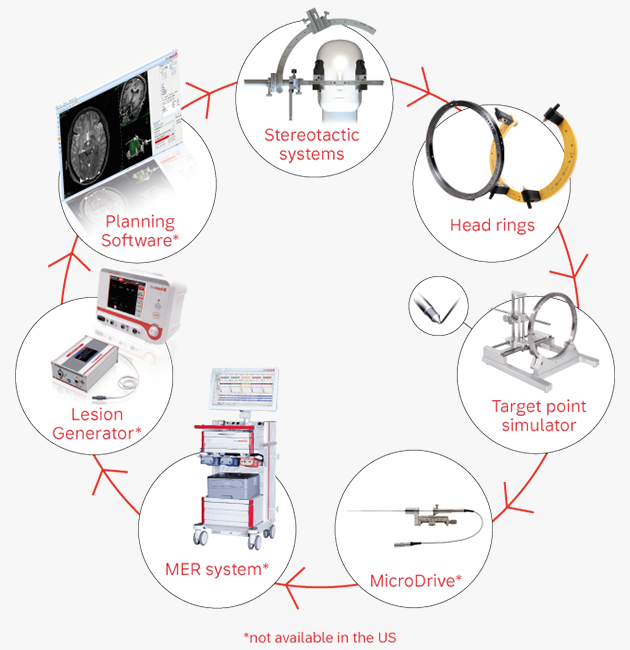
Graphic: Devices and accessories for functional neurosurgery
inomed offers comprehensive complete solutions for functional neurosurgery, covering the full range of requirements with a modern product range developed specifically for the demands of the field. This includes stereotactic systems, MER recording systems, the MicroDrive, the inomed Planning Software (iPS), RF lesion generators, electrodes and various accessories. With this comprehensive system, inomed supports neurosurgeons in performing interventions with high precision and safety, while improving the quality of life of patients.

Relevant products for the application field

ZD module unit with micrometer advance
802010
ZD module unit with micrometer advance
Center-of-arc principle, working length of 190 mm, single-point fixation for flexible and easy mounting, lateral and AP mounting options. The scope of delivery also includes instrument holders and instrument guides in two sizes (2–3 mm and 4–8 mm) as well as a matching cleaning tray.
Go to product page
Add to watch list
Target point simulator complete (for titanium head ring unit)
803400
Target point simulator complete (for titanium head ring unit)
Compatible with all inomed stereotactic systems. The set includes the TPS, a simulator mounting ring for the ceramic ring made of aluminium as well as a sterilization box.
Go to product page
Add to watch list

Relevant accessories for the application field

Head ring unit CT compatible for convergence radiation
803004
Head ring unit CT compatible for convergence radiation
The set consists of a head ring made of titanium, 4 head fixing posts each in size M (46.5 mm) and XL (91.5 mm), 4 carriers for head fixing posts, 4 fixing pins each in 40 mm, 50 mm, 60 mm and 70 mm, a multi-socket wrench, a torque wrench and a sterilization tray.
Add to watch list
CT localization set for titanium & aluminium head ring
809050
CT localization set for titanium & aluminium head ring
The Rev R localization set is designed for use with the closed titanium ring. If necessary, the anterior plate can be removed. The item is supplied in a transport case.
Add to watch list
OSS head ring unit
OSS head ring unit
803005
OSS head ring unit
The set consists of a head ring made of ceramic, 4 CFRP head fixing posts, an aluminium locking bow for the option of AP mounting, 4 fixing pins each in 40 mm, 50 mm, 60 mm and 70 mm, a multi-socket wrench, a torque wrench and a sterilization tray.
Add to watch list
CT/MR localization set for OSS incl. transport case
809045
CT/MR localization set for OSS incl. transport case
The Rev U localization set is designed for use with the open ceramic ring. If necessary, the anterior plate can be removed. The item is supplied in a transport case.
Add to watch list
Positioning aid for inomed stereotactic systems
803000
Positioning aid for inomed stereotactic systems
For quick and reliable alignment of the titanium ring on the patient’s head by a single person. Alignment in every direction is possible.
Add to watch list
Universal CT holder
Universal CT holder
809200
Universal CT holder
For clamping both inomed titanium and ceramic head ring units. The item measures 280 x 300 x 75 mm.
Add to watch list

FAQ

Is functional neurosurgery internationally recognized?

Yes, functional neurosurgery is internationally recognized and supported by leading professional associations worldwide, such as the World Society for Stereotactic and Functional Neurosurgery (WSSFN) and national professional associations. Clinical studies and the prove of efficacy for specific indications have contributed to its widespread acceptance.

What role does stereotaxy play in functional neurosurgery?

Stereotaxy is a key technique in functional neurosurgery that enables precise interventions in the brain. The target region is precisely localized in three-dimensional space using modern imaging techniques such as MRI or CT and transferred to a stereotactic coordinate system. The intervention is then performed using a stereotactic system that ensures precise placement of the instruments.

Which diseases are treated in functional neurosurgery?

Functional neurosurgery treats a variety of diseases that can be treated by targeted interventions in the nervous system. The most common indications include movement disorders such as Parkinson’s disease, essential tremor and dystonia, treatment-resistant epilepsy, chronic pain and, in exceptional cases, psychiatric illnesses such as depression and obsessive-compulsive disorder.

Log in now!

And tell us about your success

Was this page helpful?
Yes
No